Welcome to the Elstree & Borehamwood Museum blog.
This blog is about all those happenings inside and outside the Museum that have caught our attention.
From events and exhibitions, to new discoveries in the collections, to news and views.
Any comments and items to go here please contact Simon on info@elstree-museum.org.uk
We are at our penultimate 'Most Missed' building. Thanks for all your comments and suggestions and for your feedback on our Facebook, Instagram and Twitter pages. Any building you feel we have forgotten? Let us know on
Museum blog email: info@elstree-museum.org.uk
Facebook : www.facebook.com/EBWmuseum
Twitter : @EBWMuseumHerts
Instagram : https://www.instagram.com/ebwm2007/
Pubs : The Director's Arms

This building was only recently demolished and has not yet been replaced - there are ongoing planning disputes concerning the large site up Cranes Way. And the pub, originally called The Bull & Tiger and latterly The Director's Arms, is one among many pub buildings that have been 'repurposed' or knocked down. Maybe we don't miss the buildings, but it's the sense of community, the memories of fun nights out, and the meetings with friends that are lost when a pub closes.
Here are a few Missed Pubs in our area - some buildings are long gone, some are now put to other uses. What was your favourite?
Elstree :
The Plough - formerly the Swan, a favourite of Alfred Hitchcock, now derelict
The Artichoke - a favourite of Elizabeth Taylor and Richard Burton (among many other pubs), now The Shtiebel
The Holly Bush - a building from 1450, now a nursery
The Red Lion - demolished in 1935 to improve the junction between Barnet Lane and the High Street
Also The Farmer's Boy, The Green Dragon, The White Horse
Borehamwood :
The Red Lion - a favourite with stars from the studios opposite, now McDonalds
The Elstree Way Hotel - another star haunt, scene of 60s music gigs, now a roundabout
The Crowns - the Old Crown is now an office block under construction and the New Crown is now a Sainsbury Local
The Lord Nelson moved next door to a new building in 1935 and became The Mops & Brooms. The original pub is now a house.
Also The Woodcock, The Suffolk Punch

The Red Lion, Elstree, demolished in 1935, photo taken around 1900
Just a couple of 'Most Missed' buildings left in our list. Thanks for all your comments and suggestions and for your feedback on our Facebook, Instagram and Twitter pages. Any building you feel we have forgotten? Let us know on
Museum blog email: info@elstree-museum.org.uk
Facebook : www.facebook.com/EBWmuseum
Twitter : @EBWMuseumHerts
Instagram : https://www.instagram.com/ebwm2007/
Aldenham Bus Overhaul Works


The planned tube-train depot and repair centre for the Northern Line was already well under construction at the outbreak of World War 2. When the Northern Heights Extension was cancelled in 1939, the buildings were turned into an aircraft parts factory. After the war the area was still owned by London Transport and it was decided in the early 1950s to enlarge the buildings and create the largest bus overhaul works in the world on the 53 acre site. The Works eventually included its own canteen, social club, hostel, power station, and the famous 'tilt test' area. Buses could be stripped right down, examined and repaired and rebuilt. It was officially opened on 31 October 1956 with a staff of 1,800.
The post-war standardisation and huge size of the London Transport fleet allowed maintenance along modern production line principles, with work being carried out on a number of buses at once. Several mechanics could focus on specific parts of the vehicle rather than a single mechanic working on a single bus at a time.

However, in as little as 30 years, financial pressures led to a decline in bus maintenance standards, and the scope for overhaul of vehicles was reduced. LT's Bus Works Restructuring Programme 1983-4 was followed in October 1985 by the decision to discontinue the practice of completely overhauling each bus every four or five years. Coupled with a shrinking fleet and the arrival of numerous types of non-standard bus not suited to the Aldenham concept, made it increasingly uneconomic, and closure of the Works in November 1986 was inevitable.
The site was acquired by property developer Slough Estates and stood mostly empty except for occasional storage of cars on the vast site until being demolished in July 1996 to make way for Centennial Park.
For more information and photos please visit our current Exhibition Off The Rails - The Line That Never Was. Photos copyright Steve Fennell and Tom Chinnery.


After adding this photo of The Old Houses in Elstree on Monday, we've discovered the exact dates of their building and demolition. The false half-timbered front was added in 1923 by Sir Trevor Dawson to some existing cottages. Wyn Everett in her book described them as 'Elizabethan' but if you look at this photo taken before they were 'improved' you can't see any Tudor features.

They were demolished in 1968 and the current flats and shops built as a replacement. We would love to know what they were like inside before they were demolished.
Next weeks' 'Most Missed' is on the way...
Here is the next on our list of the 'Most Missed' buildings in our area. They are in no particular order, and we are adding them one by one, week by week, and would love to have your feedback on our Facebook, Instagram and Twitter pages. What are your memories? Which is your 'Most Missed'? What iconic building have we forgotten? Let us know on
Museum blog email: info@elstree-museum.org.uk
Facebook : www.facebook.com/EBWmuseum
Twitter : @EBWMuseumHerts
Instagram : https://www.instagram.com/ebwm2007/
The Old Houses In Elstree
The Old Houses in the 1920s
Upon seeing the photos of this line of houses on Elstree High Street many people assume they were original Elizabethan half-timbered houses, and are shocked they were demolished in the 1960s. But their history is not that simple. A quick examination of the buildings shows that there are no overhanging upper stories or uneven roof lines which are so characteristic of Elizabethan construction. You only have to look at the 15th century Holly Bush Pub further down the hill to see what I mean.

The Old Houses In The Snow
Sad to say they were created in the early 1900s by Sir Trevor Dawson, the wealthy head of Vickers Armaments, at the same time as he built his 'country' retreat of Edgewarebury House. His penchant for half-timbering can clearly be seen on the still existing building, now The Manor Hotel. It seems he had a supply of timber left over and persuaded the Vicar of Elstree, Richard Eales, to let him use it on existing buildings on the High Street. It could well be that the buildings he renovated were left over from Elizabethan times, but they were probably 18th Century. As a side note he used up the rest of his timber on a pub called the Duke of Marlborough somewhere on 'suicide' corner. We have never found the location of this pub, although mentioned in Wyn Everitt's biography. Any ideas?

The 1948 Olympic Marathon passes The Old Houses
The Old Houses in Elstree were demolished in the 60s and replaced by a particularly undistinguished block of flats and shops. But we have plenty of photos of them and of Sir Trevor's cortege passing down the hill in 1931 on the way to Elstree Churchyard. You shouldn't believe your eyes sometimes - like his buildings Sir Trevor was not what he seemed.


The Old Houses in the 60s
Here is the next on our list of the 'Most Missed' buildings in our area. They are in no particular order, and we are adding them one by one, week by week, and would love to have your feedback on our Facebook, Instagram and Twitter pages. What are your memories? Which is your 'Most Missed'? What iconic building have we forgotten? Let us know on
Museum blog email: info@elstree-museum.org.uk
Facebook : www.facebook.com/EBWmuseum
Twitter : @EBWMuseumHerts
Instagram : https://www.instagram.com/ebwm2007/
THE OLD CROWN

No one reading will have stepped inside this building when it was one of the original Boreham Wood pubs in Theobald Street. The Old Crown dates back to at least 1769 although rebuilt in the late 1800's, and ceased being a public house when the New Crown (now a Sainsbury's Local') was built in 1906. It was built for Clutterbuck & Co who were brewers in Stanmore and had pubs throughout Hertfordshire. By this time with the coming of the railways in the 1860s the centre of the Village was moving from Theobald Street to Shenley Road, and the New Crown was ideally placed to capture those traveling by train and living in Glenhaven Avenue and Drayton Road and further.
Before the New Crown was built in 1906 an animal pound with a pond stood close to the site. Stray farm animals would be left there for collection by their owners. A large cottage in its own grounds was also here, although we have no details and it remains something of a mystery - any information appreciated.

But the Old Crown stayed in situ and had various uses from the 1900s onwards. This area around the building is a bit of a puzzle with Swaker's Yard - a hirer of horse and carts - being in the vicinity as well. It was used for a time as the offices for Roberts the coal merchants who had a yard on the other side of Theobald Street, and lastly as the commercial premises of J.A. Michell, makers of high quality record turntables. Once they departed for Stevenage the old pub became unloved, fell into disrepair and was demolished in 2020. There is now an office building rising on the site. Our photos show the Crown over the years.


Here is the next on our list of the 'Most Missed' buildings in our area. They are in no particular order, and we are adding them one by one, week by week, and would love to have your feedback on our Facebook, Instagram and Twitter pages. What are your memories? Which is your 'Most Missed'? What iconic building have we forgotten? Let us know on
Museum blog email: info@elstree-museum.org.uk
Facebook : www.facebook.com/EBWmuseum
Twitter : @EBWMuseumHerts
Instagram : https://www.instagram.com/ebwm2007/
Last week drew many comments on the unusual photo of the MGM Clock Tower. This week should draw out many memories :
THE THATCHED BARN

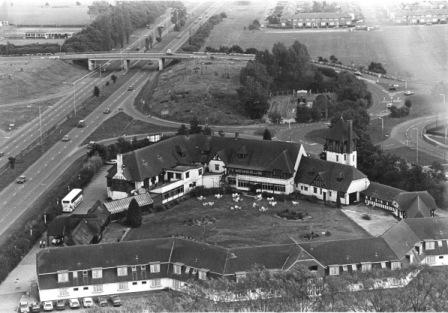
Commissioned in 1927 by a 'Mrs Merrick', of which not much is known, it was opened in 1934 on the A1 or the Barnet By-Pass. In the style of an American 'roadhouse-motel' but with an English twist with its thatched roof, it was ideally suited for 'stars' from the flourishing studios nearby to take their companions. With a large dining area, chefs, a swimming pool, and other facilities located a short drive from the expensive areas of north London it became a well-known attraction.


It was bought by holiday camps’ founder Billy Butlin in 1939 as his first hotel but then during the Second World War, his business was requisitioned by the Special Operations Executive (SOE). They turned the Barn into Station XV of the Inter Services Research Bureau and developed explosive devices, camouflage and coding equipment, using the local expertise found in the studios. It was run by film director and World War I RAF veteran Capt. J. Elder Wills, By the end of the war, the building had fallen into disrepair and the owner went bankrupt. But then, in the 1950s, the Ministry of Works used the Thatched Barn as its Building Research Station.
Restored to its original function in the 60s it was still attracting stars as well as locals to dances, swimming galas, etc. Unfortunately in 1962 it suffered the first of a series of fires which damaged the thatched roof for which it was famous. It then became a Playboy Club for a brief period in the Sixties but prohibitively high prices and an exclusive membership ensured its eventual failure. The Thatched Barn was demolished in December 1989 to be replaced by the Holiday Inn which was built in style similar to the Barn. Now it's a Double Tree by Hilton Hotels and still in a prominent position for travellers.
We are continuing our list of some of the 'Most Missed' buildings in our area, in no particular order, and we are adding them one by one, week by week, and would love to have your feedback on our Facebook, Instagram and Twitter pages. What are your memories? Which is your 'Most Missed'? What iconic building have we forgotten? Let us know on
Museum blog email: info@elstree-museum.org.uk
Facebook : www.facebook.com/EBWmuseum
Twitter : @EBWMuseumHerts
Instagram : https://www.instagram.com/ebwm2007/
We had some great comments about the Village Hall last week, and expect even more with this week's :
THE MGM CLOCK TOWER

In 1935 Amalgamated Studios started building a large studio complex on the north side of Elstree Way, including the much loved art deco tower which became a symbol of Borehamwood and its studios. Amalgamated was unable to find work to fill its new studios and in 1939 they sold out to J Arthur Rank who leased it to the Ministry of Works during the Second World War for storage. In 1944 the UK subsidiary of Metro-Goldwyn-Mayer, MGM-London, who had been using Denham Studios pre-war, purchased the site and renamed itself as MGM British Studios Ltd.


After the War MGM increased the site to 7 sound stages and went into full production and many 'classic' films and TV series were made in Borehamwood. Films included Ivanhoe (1952), The Inn of the Sixth Happiness (1958) and The Dirty Dozen (1967). The castle built as a set for Ivanhoe could be seen when driving into Borehamwood and was often mistaken for a genuine historical monument. The mound where the castle was built, is now part of the Film and Heritage Trail which runs through the Studio Way estate. The TV series The Prisoner was made here in the Sixties, and still attracts a loyal following. One of the final films to be made was 2001 : A Space Odyssey (1968) which may well have led to the closure of the studios, but has had a lasting effect in popular culture.

So in 1970, the Studios closed and in the early hours of May 1973, a fire swept through the site, damaging a number of buildings being demolished in preparation for use as a cold store by Christian Salvesen. During 1973, a film crew for the production Holiday On The Buses filmed some of the demolition work as part of the climax of the film.
In 1987, despite local campaigns and protests, the iconic Clock Tower was demolished when Christian Salvesen finished operations at the former studio. Unfortunately none of the buildings were listed and the site was cleared for industrial purposes. The former library and leisure centre were built on an adjacent site and the backlot became the Studio Way estate. According to former Museum Curator, Alan Lawrence, only a few bricks remain from the original wall alongside the road, marking where the Studios once stood.
The first photo is an unusual shot of the Tower and the offices in its early days before MGM bought the studios, but surrounded by executive cars of the day. We have no date for this shot, so if you can help us and identify the cars, then please let us know.
The second is a snowy day in the 1960s, the third is a frontal shot, and the fourth an aerial photo showing the Tower's location in the MGM complex itself. As an added bonus, here's a still from Ivanhoe as the 'castle' is besieged.

A book about the history of MGM has been written by local historian Paul Welsh and can be purchased from the Museum and this website.
Today we are beginning our list of some of the 'Most Missed' buildings in our area, in no particular order. We are adding them one by one, week by week, and would love to have your feedback on our Facebook, Instagram and Twitter pages. What are your memories? Which is your 'Most Missed'? What iconic building have we forgotten? Let us know on
Facebook : www.facebook.com/EBWmuseum
Twitter : @EBWMuseumHerts
Instagram : https://www.instagram.com/ebwm2007/
THE VILLAGE HALL
.jpg)
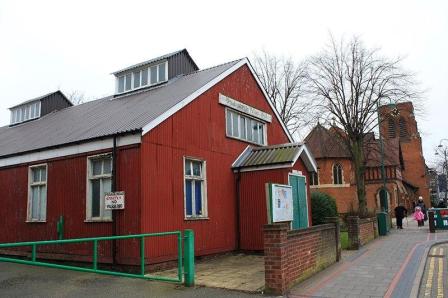
The 'Village Hall' known as the Church Hall, was opened next to All Saints Parish Church on Friday 2nd February 1926. The following afternoon a whist drive took place followed by a public dance with the 'Pogo' orchestra of banjo, piano, violin and cello. On Sunday the hall was welcomed for use by the Sunday school. Thus began an extension of the social life of the growing village of Borehamwood.
The prefabricated corrugated iron structure of the Hall was inspired by the social hall belonging to the Wellington and Ward photographic factory in Shenley Road (known as the Dufay Hall when that firm had the premises.) The 1920s saw the era of ‘Tin Tabernacles’ made of this metal, which resisted bending.
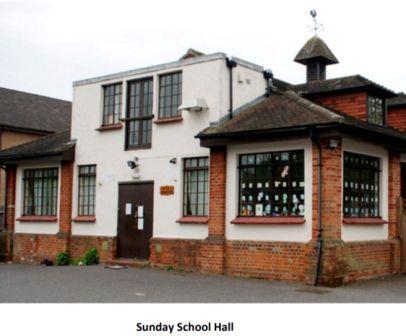
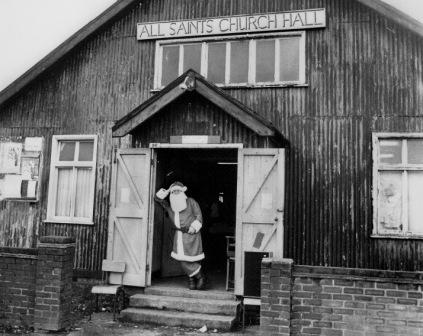
By 1936 arrangements were completed for the erection behind the Village Hall of the new brick built Sunday School Hall. During World War II the Village Hall, because of the central position, was requisitioned for government use. In the early War years it was an A.R.P. Post and ambulance station, also used in liaison with Police and Fire Services and local Hospitals, and with public utilities for water, gas and electricity. From 1943 the Village Hall did service as a ‘British Restaurant’ run by the government at subsidised rates, providing lunchtime meals, (ration book free ) for one shilling. Along with these activities, on Saturday afternoons the Hall was transformed for evening dances; a welcome social event for Servicemen and women based in the area mixing with local people.
In the 1950s both the Village Hall and the Sunday school hall were being used for a great deal of community and church related activities, meetings, dances, Easter and Christmas bazaars, The May Festival, Scouts and Guides, jumble sales, plays, film shows, exhibitions, cage bird shows, garden show, whist drives, annual dinners, talks, concerts etc. An interesting record of diversity. A weekly ‘flea’ market thrived until it closed down. Blood donation sessions were held there as well on a regular basis. In the late 1950s and early 1960s ‘Lucky’ Parkinson promoted Rock & Roll shows in The Hall, and the likes of Screaming Lord Sutch & The Savages, The Brook Brothers and Johnny Kidd & The Pirates would shake the foundations.
During the mid 1990s, a working party was set up with All Saints Church liaising with the Trustees to look into the future of the halls. One idea was to demolish the front hall, remove the wooden pews from the church and use the church space as a multi purpose facility for the community. However, by this time the front hall had become rather dilapidated and despite a makeover it remained in a poor state. Yet the hall, being in such a central location was a much loved and missed feature of the village.
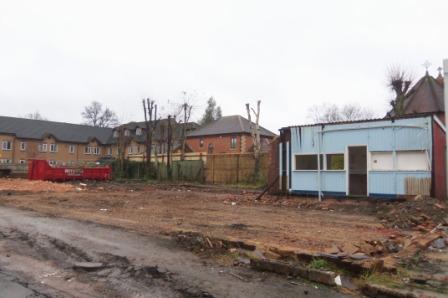
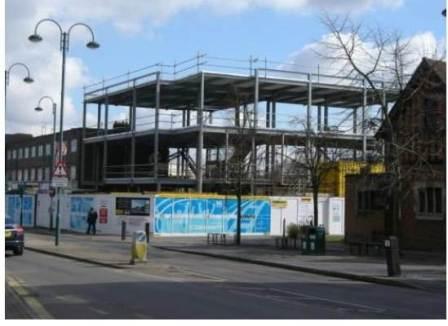
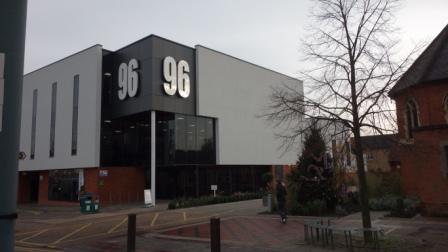
By October 2008 plans were prepared for the new community hall. This was to be a building of substance, balancing All Saints church itself, rising a storey above nearby shopping premises. The Library was to be accommodated with the inclusion of the Local museum and various meeting halls and rooms. The multi functional community building of 96 Shenley Road opened in 2013.
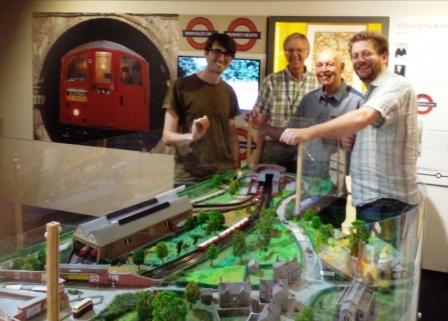
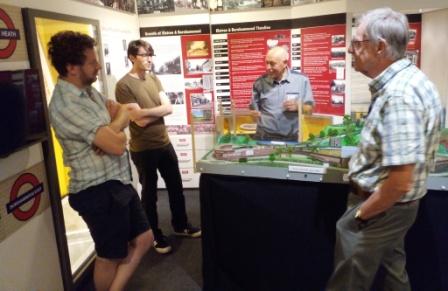
Jay, Dave Armitage - Museum Manager, Tony DeSwarte - Model Maker, Paul
If you've visited our current exhibition Off The Rails, you will have seen the video we are showing which gives the background to The Line That Never Was. Created by Jay Foreman and Paul Kendler in 2009 the video tells the story in an excellent, succinct and idiosyncratic way to help us understand what happened before and after the Second World War.
They spent much time with us examining our exhibition and explaining how they made the video and the pitfalls they encountered along the way. This was the first of their "Unfinished London" series and please visit Jay's YouTube page here to see more videos, and not just on London's weird history either.
If you haven't visited us yet, we've now extended the exhibition until September 4th, and the model trains are still running.
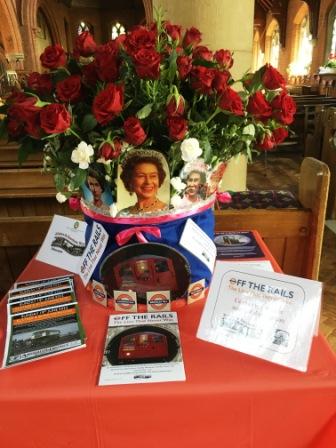
The Museum's contribution to the 2022 Flower Festival for the Civic Fortnight in All Saint's Church features red and white roses and our now 'famous' tube train photo. There are 16 local organisations with flower arrangements on the theme of the Jubilee filling the church, so make sure you visit on this Saturday and Monday 20th from 11am to 1pm. You might find some tea and cake as well!
Show only:
» Events
» Collections
» News
» Exhibitions
Elstree & Borehamwood Museum
96 Shenley Road
Borehamwood
Herts
WD6 1EB
Tel: 01442 454888


Admission: Free
Opening times:
Opening times:
Tuesday, Wednesday, Thursday
12pm - 6pm
Saturday 10am - 3pm
Registered Charity No.1157770


